Skip to content
Running a successful business today requires more than just good products or services. Customers expect fast responses, personalized experiences, and seamless communication across every touchpoint. This is where a CRM (Customer Relationship Management) system becomes invaluable.
A modern CRM not only helps companies store customer information but also improves productivity, strengthens client relationships, and streamlines team workflows. Whether you’re a real estate agency, healthcare clinic, educational institution, or corporate business, the right CRM features can dramatically improve efficiency.
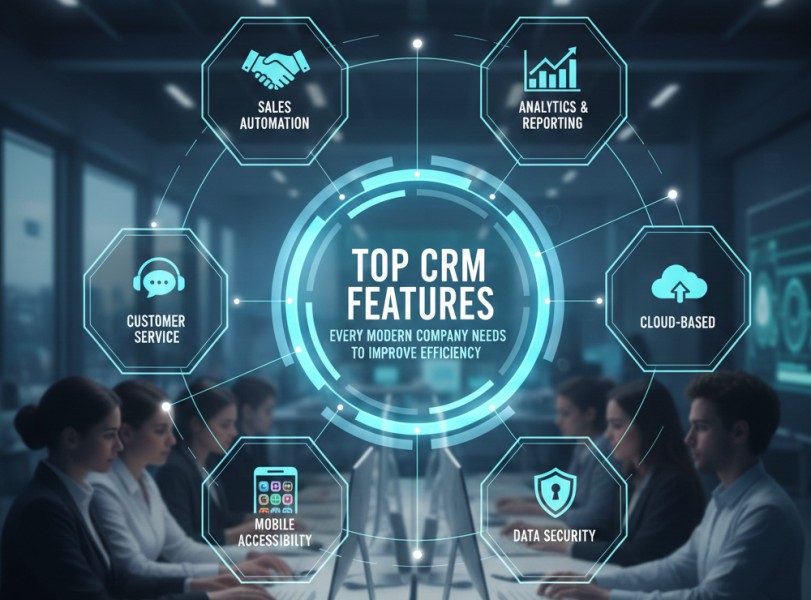
In this blog, we explore the top CRM features every modern company should look for when selecting a platform.
Centralized Customer Database
A CRM should store all customer information in one secure location.
From basic contact details to communication history, purchase records, and preferences a centralized database ensures that every department works with the same accurate information.
Why it matters
- Eliminates duplication and lost data
- Provides a complete 360° customer view
- Improves decision-making and reporting
This feature becomes even more valuable when working with multiple users such as agents, sales reps, or support teams.
Lead and Pipeline Management
An effective CRM must help businesses manage prospects through a clearly defined sales funnel.
Key capabilities
- Track new leads from multiple sources (website, ads, referrals)
- Assign leads to team members
- Monitor lead stages such as New, Contacted, Negotiation, Won, or Lost
Having a visual pipeline allows managers and executives to quickly assess performance and identify bottlenecks in the sales cycle.
Workflow Automation
Automation is one of the most powerful features of a modern CRM.
With workflow automation, companies can eliminate tedious manual tasks such as:
- Sending follow-up emails
- Changing statuses when deals close
- Assigning leads to team members
- Scheduling reminders and tasks automatically
How automation improves efficiency
- Saves time on repetitive work
- Reduces human error
- Ensures customers never miss important updates
This directly increases productivity and enables teams to focus on revenue-generating activities.
Document & File Management
A modern CRM should make it easy to handle documents like invoices, contracts, proposals, legal agreements, or certificates.
Important document features
- Secure storage and upload
- Categorization and tagging
- Access control
- Expiry reminders
- e-Signature support
Digital document management ensures faster operations, faster deal closures, and better compliance control.
Reporting & Analytics Data-driven decision-making is essential for growth.
A CRM with strong analytics lets businesses:
- Monitor KPIs
- Track performance by agent, region, project, or campaign
- Analyze sales trends
- Identify profitable channels
- Improve forecasting
Real-time dashboards provide quick insights, helping managers make smarter and faster decisions.
Multi-User Access & Roles
Modern companies often have multiple users accessing the CRM from managers and sales teams to support staff and field agents.
Why role-based access is essential
- Maintains data security
- Prevents unauthorized access
- Keeps users focused on assigned tasks
- Allows admins to control permissions easily
This is especially useful in industries like real estate, healthcare, and education where different levels of access are required.
7. Communication & Integration Tools
Customers expect fast and unified communication.
A modern CRM should support integration with key communication platforms such as:
- SMS
- Call tracking
- Customer portals
This ensures:
- Faster client engagement
- Clear communication history
- Improved response times
Integration with third-party tools like Google Maps, payment gateways, property portals, or marketing platforms further extends CRM capabilities.
Mobile Accessibility
Remote work and mobile usage have become standard in business operations.
A CRM with mobile access allows users to:
- View records on the go
- Update leads and deals from field visits
- Receive alerts and notifications
- Work without needing a computer
This is highly beneficial for industries that work outside the office such as sales teams and real estate agents.
Conclusion
A modern CRM is no longer just a customer database it’s a complete business management system.
By selecting a CRM with the right features such as centralized data, automation, document management, role-based access, strong reporting, integrations, and mobile access companies can achieve:
- Higher productivity
- Stronger client relationships
- Improved conversion rates
- Better team coordination
- Faster, more informed decision-making
Whether your business operates in real estate, healthcare, education, finance, or services the right CRM can transform operations and accelerate growth.