Skip to content
As businesses grow, managing customers, sales, finances, inventory, and operations becomes increasingly complex. Many organizations eventually realize that spreadsheets and disconnected software are no longer enough to support efficient workflows.
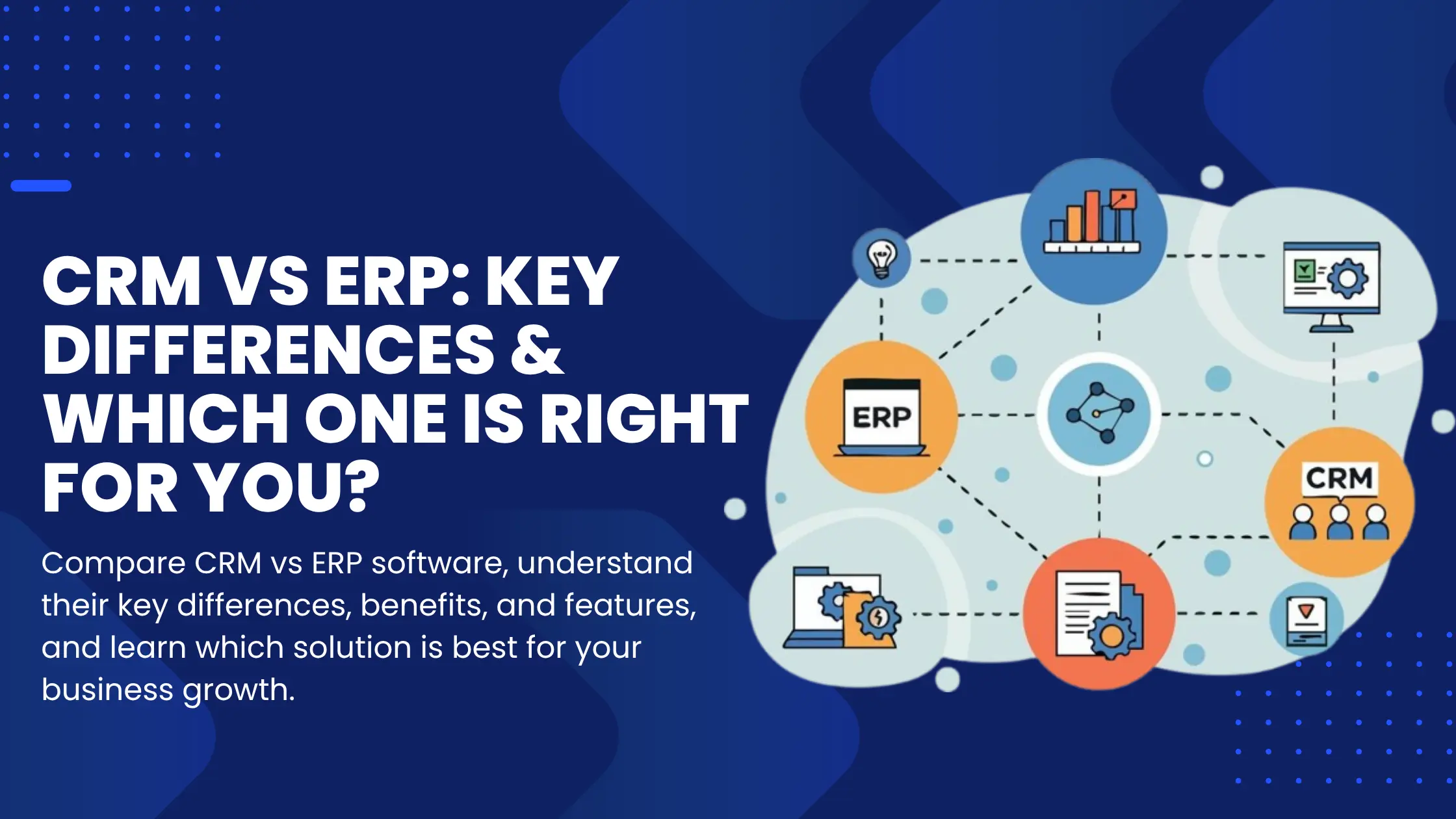
This is where business management software comes in. Two of the most common solutions are Customer Relationship Management (CRM) systems and Enterprise Resource Planning (ERP) systems.
Although both help businesses improve efficiency and centralize information, they serve very different purposes. Choosing the wrong system can lead to unnecessary costs, poor adoption, and operational inefficiencies.
This guide explains the differences between CRM and ERP, their key features, benefits, and how to decide which solution best fits your business.
What Is a CRM?
A Customer Relationship Management (CRM) system is designed to help businesses manage customer relationships throughout the entire customer lifecycle.
It centralizes customer information, making it easier for sales, marketing, and customer support teams to work together while providing personalized customer experiences.
Modern CRM platforms have evolved beyond simple contact management and now include automation, artificial intelligence, sales forecasting, and marketing tools.
Common CRM Functions
- Contact management
- Lead tracking
- Opportunity and deal management
- Sales pipeline visualization
- Email integration
- Marketing automation
- Customer support management
- Workflow automation
- AI-powered sales assistance
- Reporting and analytics
Example
Imagine a software company receives inquiries through its website, LinkedIn, and email campaigns.
Instead of manually tracking every lead, a CRM automatically:
- Captures new leads
- Assigns them to sales representatives
- Sends follow-up emails
- Tracks every interaction
- Reminds sales teams about upcoming meetings
- Measures conversion rates
Everything is managed from one centralized platform.
What Is an ERP?
An Enterprise Resource Planning (ERP) system helps businesses manage internal operations across multiple departments.
Rather than focusing on customers, ERP software integrates core business functions such as finance, procurement, inventory, manufacturing, human resources, and supply chain management.
The goal is to eliminate data silos and create one unified system for business operations.
Common ERP Functions
- Financial management
- Accounting
- Procurement
- Inventory management
- Warehouse management
- Manufacturing planning
- Supply chain management
- Human resources
- Payroll
- Project management
- Asset management
- Business reporting
Example
A manufacturing company produces electronic devices.
An ERP system can automatically:
- Monitor inventory levels
- Generate purchase orders
- Schedule production
- Track supplier deliveries
- Calculate manufacturing costs
- Process invoices
- Update financial records
Instead of separate software for each department, everything works together in one integrated system.
CRM vs ERP: The Key Differences
Customer Relationship Management (CRM)
Primary Purpose
- Manage customer relationships
- Increase sales opportunities
- Improve customer satisfaction
Core Features
- Contact management
- Lead management
- Sales pipeline tracking
- Opportunity management
- Marketing automation
- Email integration
- Customer support tools
- Workflow automation
- AI-powered sales assistance
- Reporting and analytics
Main Users
- Sales teams
- Marketing teams
- Customer support representatives
- Account managers
Business Focus
- Customer acquisition
- Customer retention
- Sales growth
- Relationship building
Example
A sales representative uses a CRM to track leads, schedule follow-ups, automate emails, and monitor deals until they are closed.
Enterprise Resource Planning (ERP)
Primary Purpose
- Manage internal business operations
- Streamline business processes
- Improve operational efficiency
Core Features
- Financial management
- Accounting
- Inventory management
- Procurement
- Manufacturing planning
- Supply chain management
- Human resources
- Payroll
- Project management
- Business intelligence reporting
Main Users
- Finance teams
- Operations managers
- HR departments
- Warehouse managers
- Procurement teams
Business Focus
- Resource planning
- Operational efficiency
- Cost reduction
- Business process automation
Example
A manufacturing company uses an ERP to manage inventory, generate purchase orders, schedule production, process invoices, and track financial performance.
Benefits of CRM
Businesses invest in CRM software because it directly improves customer engagement and sales performance.
Key Benefits
- Centralized customer information
- Better lead management
- Improved customer communication
- Faster sales cycles
- Increased conversion rates
- Personalized customer experiences
- Automated follow-ups
- Better collaboration between teams
- Accurate sales forecasting
- AI-powered productivity tools
Example
A real estate agency can automatically assign new property inquiries to agents, send viewing confirmations, and schedule reminders, reducing manual work while improving customer satisfaction.
Benefits of ERP
ERP systems streamline operations by connecting different departments into one integrated platform.
Key Benefits
- Unified business operations
- Improved inventory accuracy
- Better financial visibility
- Reduced manual data entry
- Faster procurement
- Improved production planning
- Regulatory compliance
- Better resource allocation
- Real-time reporting
- Lower operational costs
Example
A retail company can automatically reduce inventory after each sale, reorder stock when quantities fall below a threshold, and update accounting records without manual intervention.
When Should You Choose a CRM?
CRM software is ideal for businesses that prioritize customer acquisition, relationship management, and revenue growth.
A CRM may be the right choice if your business:
- Has a growing customer base
- Generates leads from multiple channels
- Has a dedicated sales team
- Wants better follow-up processes
- Needs marketing automation
- Struggles with customer communication
- Wants detailed sales reporting
- Plans to improve customer retention
Example
A digital marketing agency managing hundreds of clients would benefit from a CRM that tracks proposals, meetings, contracts, and customer communications in one place.
When Should You Choose an ERP?
ERP software is better suited for organizations managing complex internal operations.
An ERP is often the right choice if your business:
- Manages inventory
- Operates warehouses
- Handles manufacturing
- Processes large purchase orders
- Needs advanced accounting
- Has multiple departments
- Requires supply chain visibility
- Needs financial compliance reporting
Example
A furniture manufacturer can use ERP software to coordinate production schedules, inventory, purchasing, and financial reporting across several factory locations.
When Do You Need Both CRM and ERP?
Many growing businesses eventually require both systems.
A CRM manages the front office by handling customer interactions, while an ERP manages the back office by overseeing operations.
When integrated, they create a seamless flow of information across the organization.
Example Workflow
- A customer submits an inquiry through the company’s website.
- The CRM captures the lead and assigns it to a salesperson.
- The salesperson closes the deal.
- The order is automatically sent to the ERP.
- The ERP checks inventory availability.
- Production or fulfillment begins.
- Accounting generates an invoice.
- Shipping information is updated.
- The CRM notifies the customer about order status.
This integration eliminates duplicate data entry and keeps every department aligned.
Industries That Benefit from CRM and ERP
Different industries rely on these systems in different ways.
CRM is commonly used by:
- Marketing agencies
- SaaS companies
- Insurance providers
- Real estate agencies
- Financial services
- Healthcare providers
- Educational institutions
ERP is commonly used by:
- Manufacturing companies
- Wholesale distributors
- Construction firms
- Retail businesses
- Logistics companies
- Pharmaceutical companies
- Automotive manufacturers
Businesses that often use both include:
- Large retailers
- E-commerce companies
- Manufacturing enterprises
- Healthcare organizations
- Telecommunications providers
- Enterprise software companies
Factors to Consider Before Choosing
Before investing in any business management software, evaluate your organization’s current and future needs.
Consider the following:
- Business size
- Number of employees
- Budget
- Customer volume
- Inventory complexity
- Required integrations
- Scalability
- AI capabilities
- Ease of implementation
- Data security
- Reporting requirements
- User training and support
Choosing software that can scale with your business will reduce future migration costs and support long-term growth.
Can CRM and ERP Work Together?
Yes. Many modern platforms offer native integrations or APIs that allow CRM and ERP systems to exchange data automatically.
Common integration benefits include:
- Shared customer records
- Automatic order synchronization
- Real-time inventory updates
- Unified financial reporting
- Faster customer service
- Reduced manual work
- Improved forecasting
- Better decision-making
Organizations that integrate both systems often gain greater visibility into customer relationships and business operations, enabling teams to work more efficiently.
Final Thoughts
CRM and ERP systems solve different business challenges, but both are essential for improving efficiency and supporting long-term growth.
A CRM focuses on building stronger customer relationships, managing sales pipelines, and increasing revenue. An ERP focuses on optimizing internal processes such as finance, inventory, procurement, manufacturing, and human resources.
For many small businesses, a CRM is the first investment because customer acquisition and relationship management drive early growth. As operations become more complex, adding an ERP can help streamline internal workflows and improve overall business performance.
By understanding the strengths of each system and aligning your choice with your business goals, you can invest in technology that supports both current needs and future expansion.