Skip to content
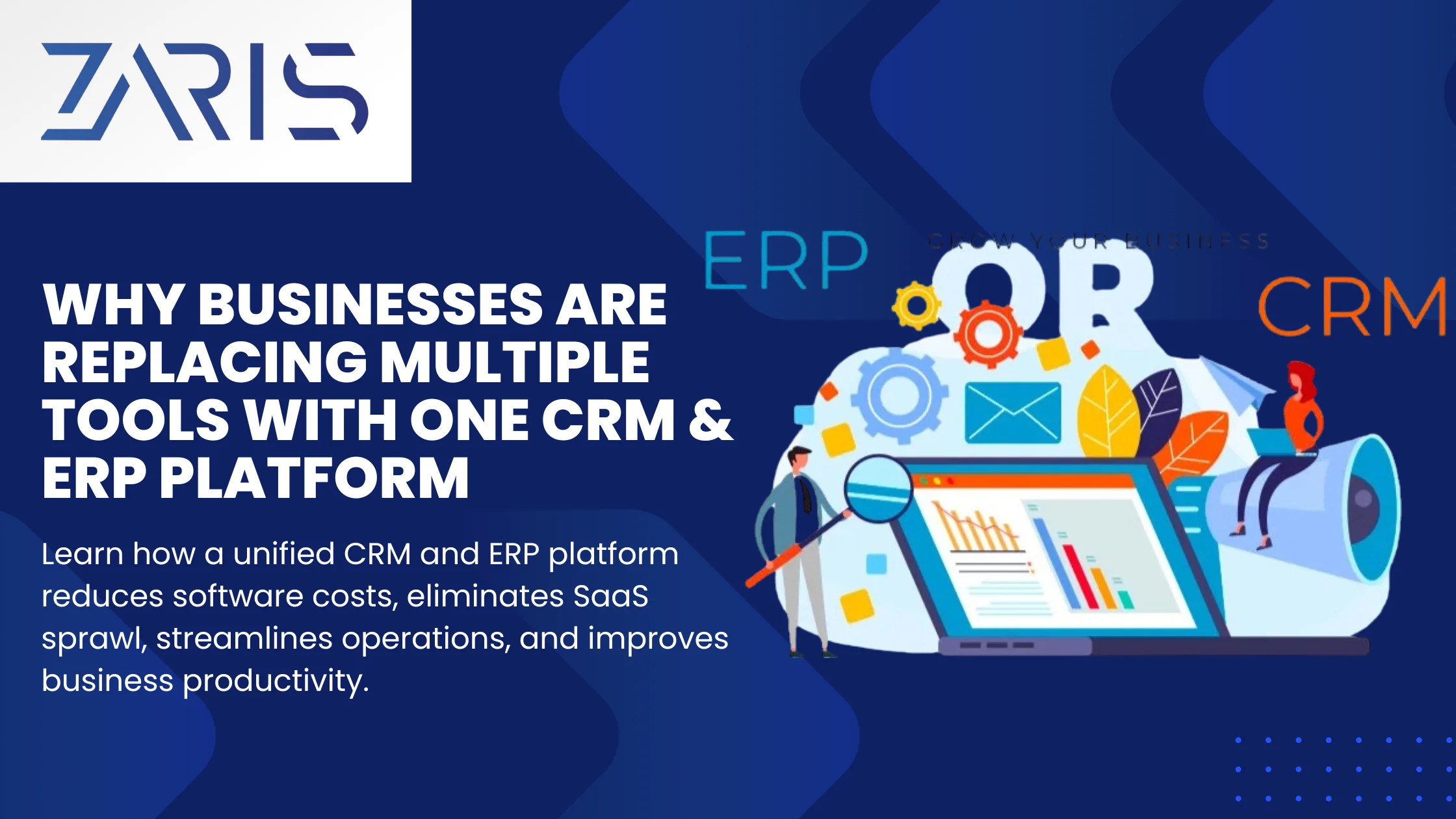
Introduction: The Fragmented Stack Crisis
Over the last decade, businesses embraced specialized Software-as-a-Service (SaaS) applications to solve individual operational challenges. Teams adopted separate platforms for customer relationship management, accounting, inventory, marketing automation, project management, customer support, payroll, procurement, and analytics. While this “best-of-breed” strategy initially improved departmental productivity, it has created a new enterprise challenge: SaaS sprawl.
Today, organizations often manage dozens—or even hundreds—of software subscriptions across departments. Beyond the obvious licensing expenses, this fragmented technology landscape introduces operational complexity, inconsistent data, integration maintenance, and rising administrative costs. In fact, 41% of business owners have reported increasing software expenses, making technology consolidation a growing executive priority.
The financial impact is only part of the problem.
Employees constantly experience context switching, moving between multiple applications to complete a single workflow. Research consistently shows that regaining deep focus after interruptions can take 15–25 minutes, significantly reducing productivity across sales, finance, operations, and customer service teams.
At the same time, IT departments face integration fatigue. Every API connection, middleware platform, and automation workflow introduces another potential failure point. A minor software update can break critical business processes without warning, forcing teams into reactive troubleshooting instead of strategic innovation.
As organizations become increasingly dependent on accurate, real-time information, fragmented software ecosystems are becoming a competitive disadvantage.
The shift toward unified, cloud-native CRM and ERP platforms is no longer simply about reducing subscription costs. It has become a strategic investment in operational resilience, scalable growth, and long-term digital transformation.
The Hidden Cost of a Fragmented Software Stack
Many organizations evaluate software based solely on monthly subscription pricing. However, the actual financial impact extends far beyond license fees.
A fragmented environment creates operational costs that rarely appear on procurement reports but accumulate across every department.
Hidden expenses commonly include:
- Multiple overlapping software subscriptions
- Integration middleware and API connector costs
- Custom integration development
- Ongoing maintenance for automation workflows
- Duplicate software features across departments
- Employee training for multiple platforms
- Manual reconciliation between disconnected systems
- Forgotten or unused software subscriptions
- Increased cybersecurity management
- Higher IT support requirements
When these factors are combined, businesses often discover that their technology ecosystem costs substantially more than originally anticipated.
This is where Total Cost of Ownership (TCO) becomes a far more meaningful metric than monthly subscription pricing alone.
Drastic Reduction in Total Cost of Ownership (TCO)
Understanding True Technology Costs
Total Cost of Ownership measures every expense associated with operating business software—not just purchasing it.
This includes:
- Licensing
- Infrastructure
- Maintenance
- Administration
- Security
- Integration management
- Employee productivity
- Downtime
- Vendor management
Many businesses unknowingly pay multiple vendors for similar functionality.
For example:
- CRM platform
- Marketing automation software
- Email campaign tool
- Customer support software
- Accounting system
- Inventory management software
- Procurement software
- Reporting dashboard
- Workflow automation platform
While each application solves a specific problem, collectively they increase operational overhead.
Where financial leakage occurs
Organizations frequently experience:
- Duplicate contact databases
- Multiple reporting systems
- Redundant automation platforms
- Separate authentication systems
- Multiple billing cycles
- Unused licenses after employee turnover
- Legacy subscriptions that no longer deliver value
These “forgotten subscription taxes” gradually inflate operational expenditure (OpEx) without providing proportional business value.
Why Unified Cloud Platforms Lower IT Costs
Modern cloud-native CRM and ERP platforms consolidate numerous operational functions into a single ecosystem.
Instead of maintaining dozens of independent applications, organizations centralize:
- Customer management
- Sales
- Finance
- Inventory
- Procurement
- Manufacturing
- HR
- Customer support
- Business reporting
This dramatically reduces:
- API maintenance
- Vendor management
- Infrastructure complexity
- Security administration
- Software procurement effort
Organizations transitioning from fragmented or legacy on-premise systems to unified cloud architectures commonly experience approximately 30% lower IT overhead during the first year, primarily due to reduced maintenance, simplified administration, and fewer integration requirements.
Rather than investing IT resources in maintaining software connections, teams can focus on innovation, automation, and business optimization.
Eliminating Data Silos & Establishing a Single Source of Truth
Why Data Silos Slow Every Department
Data is only valuable when every team can trust it.
Unfortunately, fragmented software environments often create isolated datasets that cannot communicate effectively.
A typical organization might store:
- Sales leads inside a CRM
- Orders inside an e-commerce platform
- Financial records inside accounting software
- Inventory inside warehouse software
- Customer support tickets in a help desk platform
Although each application performs its intended function, none possesses the complete operational picture.
This leads to:
- Duplicate data entry
- Conflicting customer records
- Reporting inconsistencies
- Human error
- Delayed decision-making
- Limited business visibility
Departments begin operating from different versions of the truth.
The Value of a Single Source of Truth
Unified CRM and ERP platforms create a centralized data architecture where information flows naturally across departments.
Instead of synchronizing multiple databases through fragile integrations, every department accesses the same real-time information.
For example:
Traditional Fragmented Workflow
- Sales closes a deal.
- Employee manually enters order information.
- Finance creates the invoice separately.
- Inventory updates stock manually.
- Purchasing checks inventory later.
- Reporting systems refresh overnight.
This process introduces delays and multiple opportunities for error.
Unified CRM & ERP Workflow
- Customer record updates instantly after a deal is won.
- Sales order is generated automatically.
- Inventory adjusts in real time.
- Procurement reorder thresholds are evaluated.
- Financial ledger entries are created.
- Invoice generation begins.
- Reporting dashboards update immediately.
No duplicate data entry.
No manual reconciliation.
No disconnected systems.
This seamless data flow significantly improves operational efficiency while reducing administrative workload.
Next-Gen AI Requires Unified Data Architecture
Why Fragmented Systems Limit Artificial Intelligence
- Artificial intelligence is rapidly becoming a core capability within enterprise software.
- However, AI effectiveness depends entirely on data quality.
- Many organizations attempt to add AI assistants onto disconnected software ecosystems.
- The result is often disappointing.
An AI assistant connected only to CRM data cannot understand:
- Inventory availability
- Financial status
- Procurement timelines
- Supplier performance
- Manufacturing schedules
Without complete business context, AI recommendations remain incomplete.
This is why bolted-on AI solutions frequently struggle to deliver meaningful operational value.
Unified Platforms Enable Context-Aware AI
Modern CRM and ERP platforms embed AI directly into their unified data architecture.
Instead of analyzing isolated datasets, AI engines gain access to interconnected operational information across the business.
This enables sophisticated capabilities such as:
Financial automation
- Automated invoice scanning
- Expense categorization
- Bank reconciliation
- Fraud anomaly detection
Supply chain intelligence
- Predictive demand sensing
- Inventory forecasting
- Procurement optimization
- Supplier risk analysis
Customer operations
- Intelligent lead prioritization
- Sales forecasting
- Customer churn prediction
- Personalized engagement recommendations
Operational optimization
- Workflow automation
- Resource allocation
- Capacity planning
- Predictive maintenance
Because every department contributes to the same centralized database, AI can understand relationships across the entire organization rather than isolated transactions.
This produces faster, more accurate, and more actionable business insights.
Fragmented Multi-Tool Stack vs Unified CRM & ERP Platform
| Feature | Fragmented Multi-Tool Stack | Unified CRM & ERP Platform |
|---|---|---|
| Data Storage | Multiple disconnected databases | Single centralized database |
| Reporting | Inconsistent across departments | Unified real-time reporting |
| Data Entry | Frequent duplicate entry | Automated data synchronization |
| Integrations | Numerous API connections | Native platform integration |
| Maintenance | High IT overhead | Simplified administration |
| AI Capabilities | Limited by incomplete context | Full business context for AI |
| Security Management | Multiple vendors and policies | Centralized governance |
| Operational Visibility | Department-specific | Organization-wide visibility |
| Software Costs | Multiple subscriptions | Consolidated licensing |
| Scalability | Increasing complexity | Scalable cloud-native architecture |
Why Executives Are Prioritizing Platform Consolidation
Technology leaders are no longer evaluating software solely based on individual features.
Instead, executive priorities increasingly include:
Operational resilience
- Reduced dependence on fragile integrations
- Consistent business continuity
- Simplified system administration
OpEx optimization
- Lower software licensing costs
- Reduced infrastructure spending
- Smaller maintenance burden
Better governance
- Improved compliance
- Centralized security controls
- Standardized business processes
Faster decision-making
- Organization-wide visibility
- Real-time analytics
- Trusted operational data
AI readiness
- Clean enterprise data architecture
- High-quality business intelligence
- Scalable automation capabilities
Rather than continually adding new software, organizations are focusing on simplifying their technology ecosystems to improve long-term adaptability.
Conclusion
The organizations achieving the greatest operational efficiency are not necessarily those with the largest software portfolios they are the ones with the strongest data foundations.
Fragmented software stacks increase operational costs, create data silos, introduce API friction, and limit the effectiveness of emerging AI technologies. While individual applications may excel within their respective functions, maintaining dozens of disconnected systems often undermines enterprise agility.
Unified CRM and ERP platforms address these challenges by consolidating business operations into a single cloud-native ecosystem. They reduce Total Cost of Ownership, eliminate duplicate data, establish a single source of truth, and provide the connected data architecture required for intelligent automation and AI-driven decision-making.
As businesses continue modernizing their operations, platform consolidation is becoming less about reducing software licenses and more about building an adaptable, future-ready enterprise.
If your organization still relies on multiple disconnected applications, now is the time to conduct a comprehensive SaaS audit. Calculate the true cost of maintaining your existing technology stack, identify overlapping functionality, and evaluate whether a unified CRM and ERP platform can deliver greater operational efficiency, lower long-term costs, and a stronger foundation for future growth.