Skip to content
Your sales team is busy. Your inbox is overflowing. Customers are asking for updates, leads are trapped in spreadsheets, and everyone insists they’re “following up.”
Yet, deals keep slipping away.
If this sounds familiar, the problem likely isn’t your team’s effort. It’s the way information moves or, more accurately, fails to move through your business.
Many growing companies delay investing in a Customer Relationship Management (CRM) system. Spreadsheets feel familiar, and switching software sounds like another project no one has time for. Ironically, that’s usually the exact moment a CRM becomes less of a “nice-to-have” and more of a practical necessity.
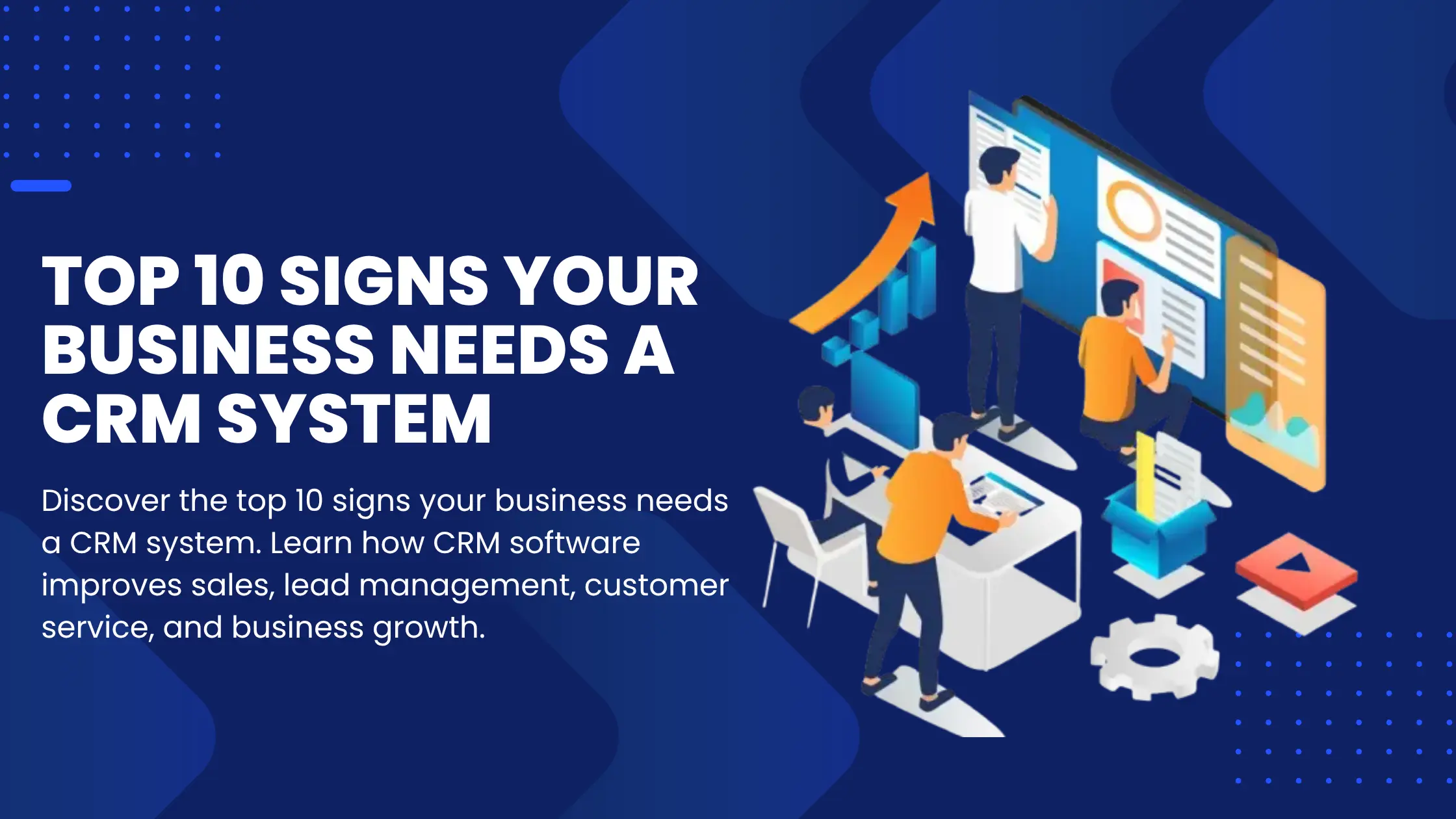
Here are ten clear signs your business needs a CRM system.
1. Lead Amnesia: Hot Leads Keep Disappearing
Every business has experienced it: a promising prospect fills out a contact form; someone writes their details on a sticky note; another employee saves them in a spreadsheet; a follow-up reminder gets buried in an email thread.
A week later, nobody remembers who was supposed to call.
The result isn’t just one lost opportunity it becomes a pattern.
Warning signs include:
- Leads stored in multiple spreadsheets.
- Customer details scattered across personal emails.
- Sticky notes covering desks.
- Missed follow-up reminders.
- Duplicate contact records.
When leads aren’t stored in one central place, they’re surprisingly easy to forget.
2. Nobody Knows Who Last Spoke to the Customer
One salesperson calls a client. Another sends the exact same email the next morning. Meanwhile, someone else assumes the opportunity has already been handled.
The customer notices.
Without a shared communication history, conversations become disconnected and awkward. Even worse, some customers receive too much attention while others hear nothing at all. A central record of every call, email, meeting, and note removes the guesswork and ensures a seamless customer experience.
3. Sales Forecasting Feels Like Guesswork
When someone asks, “How much revenue are we expecting next month?” does the answer begin with “I think…” or “Probably…”?
That uncertainty makes planning for hiring, inventory, marketing budgets, and cash flow nearly impossible. Instead of relying on instinct, businesses need visibility into:
- Active opportunities.
- Deal stages and expected close dates.
- Win rates.
- Total pipeline value.
A forecast should be based on data not optimism.
4. Training New Sales Reps Takes Forever
Some businesses don’t actually have a sales process they have one experienced salesperson who remembers everything: customer preferences, past conversations, pricing exceptions, and special requests.
When that person is unavailable or leaves the company that knowledge disappears with them. New hires spend weeks asking questions instead of closing deals. A CRM creates a repeatable process where customer history stays with the business, not individual employees.
5. Customer Service is Always Playing Catch-Up
A customer calls with a problem. Support checks email, then Slack, then spreadsheets, then old invoices, then asks another department. By the time someone finds the answer, the customer is already frustrated.
Great customer service isn’t about working harder; it’s about finding information quickly. When every interaction is connected in one place, support teams spend less time searching and more time solving.
6. Your Data Lives in Too Many Places
Sales has one spreadsheet. Marketing uses another platform. Accounting has its own software. Customer support keeps separate notes. Nothing connects.
The result is a business operating with several different versions of the truth. One department updates a customer’s phone number; another keeps the old one; someone else doesn’t know the customer has already purchased. Disconnected systems create unnecessary confusion. As businesses grow, shared data becomes far more valuable than isolated data.
7. Your Best Customers Don’t Feel Like Your Best Customers
Winning a customer is expensive; keeping one usually isn’t. Yet many businesses focus so heavily on acquiring new clients that they accidentally neglect existing ones.
Missed follow-ups, forgotten renewal dates, no check-ins, and no upsell conversations. High-value clients expect businesses to remember them. Simple reminders and automated follow-ups can turn occasional customers into long-term partnerships.
8. Your Team Spends More Time Updating Records Than Selling
Ask any salesperson what they enjoy least. Few will answer “updating spreadsheets.”
Manual admin work quietly consumes hours every week:
- Copying contact details.
- Logging meetings.
- Writing similar emails.
- Updating spreadsheets.
- Searching previous conversations.
None of these activities generate revenue directly. The more time spent on administration, the less time available for building relationships and closing deals.
9. You Can’t Tell Which Marketing Actually Works
You’re running Google Ads, posting on LinkedIn, sending email campaigns, publishing blogs, and attending events. Leads are arriving but where are they coming from?
Without proper tracking, marketing budgets become educated guesses. A connected CRM helps answer questions like:
- Which campaign generated this customer?
- Which channel creates the highest-quality leads?
- Which marketing activities actually produce revenue?
Those answers make every future campaign smarter and more cost-effective.
10. Growth is Creating More Problems Than Opportunities
Manual processes often work well… until they don’t. Managing ten customers manually may be manageable; managing one hundred is a completely different challenge. As businesses scale, small inefficiencies become major operational issues.
When growth creates more stress than excitement, systems usually need attention. A CRM doesn’t remove complexity it helps you organize it.
The Hidden Cost of Staying on Spreadsheets
Many businesses focus only on the cost of new software. They rarely calculate the cost of doing nothing.
Consider a small sales team of five people. If each person spends just 45 minutes every day searching for customer information, updating spreadsheets, or performing repetitive admin tasks:
- 5 employees × 45 minutes = 3.75 hours lost every day.
- That becomes 18.75 hours every week.
- Nearly 1,000 hours every year.
Now add missed follow-ups, lost opportunities, duplicate work, customer frustration, and delayed responses. Even losing one valuable customer because someone forgot to follow up can cost far more than the software you were trying to avoid purchasing.
The biggest expense often isn’t the CRM; it’s the inefficiency that’s already part of your daily operations.
Before You Buy: Audit Your Current Workflow
Not every business needs the same CRM. Buying the biggest platform available isn’t automatically the smartest decision.
Before comparing software, spend an hour answering these practical questions:
- Where are customer records currently stored?
- How many tools does your team use every day?
- How often are follow-ups missed?
- Can everyone see the complete customer history?
- How long does onboarding a new salesperson take?
- Can you accurately predict next month’s revenue?
- Do you know which marketing campaigns generate paying customers?
The answers will quickly reveal where the biggest bottlenecks exist. Once you understand those problems, choosing a CRM becomes much easier because you’ll be solving specific operational issues instead of shopping based on feature lists.
Growth doesn’t usually break a business overnight. It exposes weaknesses that were already there. Fixing those weaknesses early gives your team more time to sell, support customers, and focus on the work that actually moves the business forward.
Final Thoughts
The warning signs discussed in this article rarely appear all at once. They usually start small a missed follow-up, scattered customer information, or a sales forecast based on guesswork. As your business grows, these small inefficiencies become larger operational challenges that affect productivity, customer satisfaction, and revenue.
A modern CRM software for small business helps organize customer information, automate repetitive tasks, improve collaboration, and give your team complete visibility into every stage of the customer journey. Whether you’re managing leads, tracking opportunities, or supporting existing customers, the right CRM allows your business to operate more efficiently and scale with confidence.
If you’re looking for an all-in-one CRM and ERP software, ZARIS CRM combines sales management, lead tracking, workflow automation, project management, customer support, and business operations into one powerful platform. It’s designed to help growing businesses replace disconnected tools with a single, secure, and scalable solution.
The best time to implement a CRM isn’t after your business becomes overwhelmed it’s before operational challenges begin to slow your growth.