Skip to content
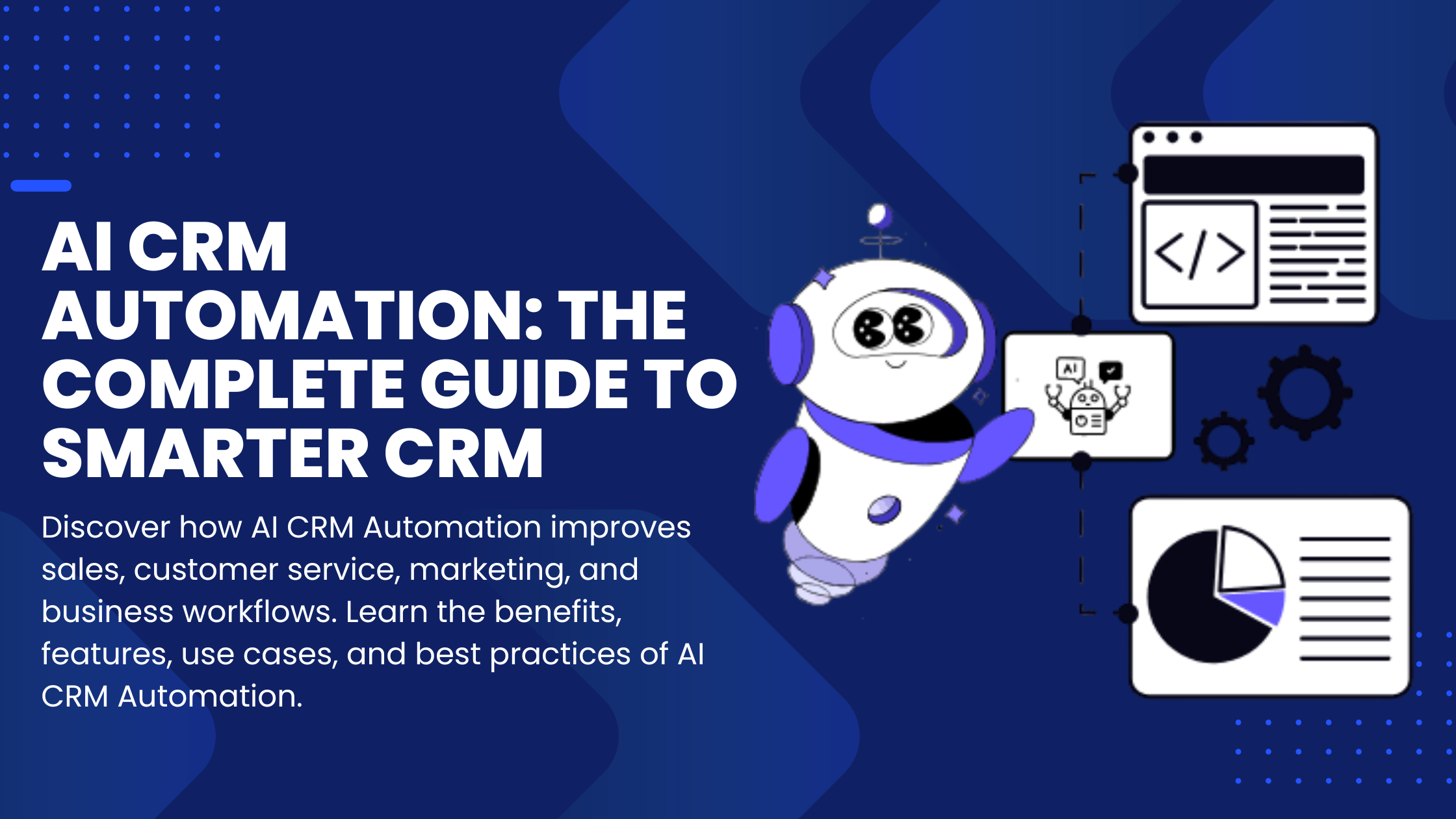
Artificial intelligence is changing the way businesses manage customer relationships. Companies no longer rely only on spreadsheets, manual follow-ups, and disconnected systems to keep track of customers. Instead, they are adopting AI CRM Automation to streamline operations, improve customer experiences, and increase productivity.
From automatically qualifying leads to predicting customer behavior and handling support requests, AI-powered CRM solutions help businesses work smarter rather than harder. Whether you’re a startup, a growing business, or a large enterprise, AI CRM Automation can reduce repetitive work, improve decision-making, and help your teams focus on building stronger customer relationships.
In this guide, you’ll learn everything about AI CRM Automation, including how it works, its benefits, key features, real-world use cases, implementation tips, and future trends.
What Is AI CRM Automation?
AI CRM Automation combines Artificial Intelligence (AI) with Customer Relationship Management (CRM) software to automate routine tasks, analyze customer data, and provide intelligent recommendations.
Traditional CRM systems primarily store customer information and track sales activities. AI-powered CRM platforms go much further by learning from customer interactions, predicting future behavior, automating workflows, and helping teams make faster, data-driven decisions.
Instead of manually updating records or remembering follow-ups, AI continuously works in the background to keep customer information organized and actionable.
Businesses use AI CRM Automation to:
- Automate repetitive administrative tasks
- Improve lead qualification
- Personalize customer interactions
- Increase sales productivity
- Enhance customer support
- Generate predictive business insights
- Reduce human errors
- Improve operational efficiency
How AI CRM Automation Works
AI CRM Automation analyzes customer data collected from multiple channels, including websites, emails, phone calls, live chat, social media, and CRM records.
Using machine learning and predictive analytics, the system identifies patterns and automatically performs tasks such as:
- Assigning leads to the right salesperson
- Scheduling follow-up reminders
- Sending personalized emails
- Updating customer records
- Scoring leads based on buying intent
- Recommending the next best action
- Predicting sales opportunities
- Detecting inactive customers
The more data the CRM collects, the smarter the AI becomes, allowing businesses to continuously improve their customer engagement strategies.
Key Features of AI CRM Automation
Modern AI CRM platforms include a wide range of intelligent features designed to improve efficiency and customer engagement.
AI Lead Scoring
Not every lead has the same value. AI automatically analyzes customer behavior, engagement history, company size, demographics, and buying signals to rank leads according to their likelihood of conversion.
This helps sales teams focus on the most promising opportunities.
Workflow Automation
AI automates repetitive business processes that previously required manual work.
Examples include:
- Creating tasks
- Updating records
- Sending notifications
- Scheduling follow-ups
- Assigning sales representatives
- Triggering email campaigns
- Escalating customer support cases
Automation reduces delays while improving consistency across departments.
AI Chatbots
AI chatbots provide instant customer support 24/7 without human intervention.
They can:
- Answer frequently asked questions
- Collect customer information
- Recommend products
- Schedule appointments
- Generate qualified leads
- Transfer conversations to live agents when necessary
This improves customer satisfaction while reducing support costs.
Predictive Analytics
AI analyzes historical customer data to predict future outcomes.
Businesses can forecast:
- Sales revenue
- Customer churn
- Product demand
- Purchase probability
- Upsell opportunities
- Customer lifetime value
Predictive insights help organizations make proactive business decisions instead of reacting after problems occur.
Intelligent Sales Assistance
AI assists sales teams throughout the sales cycle by suggesting next actions, generating email drafts, summarizing meetings, and highlighting high-priority opportunities.
Sales representatives spend less time on administrative work and more time building customer relationships.
Benefits of AI CRM Automation
Implementing AI CRM Automation provides measurable advantages across the entire organization.
Increased Sales Productivity
AI eliminates repetitive administrative work, allowing sales professionals to spend more time engaging with prospects and closing deals.
Better Customer Experiences
Customers receive faster responses, personalized recommendations, and timely follow-ups, leading to higher satisfaction and stronger loyalty.
Smarter Decision-Making
AI analyzes massive amounts of customer data and converts it into meaningful business insights.
Managers gain accurate reports, forecasts, and performance metrics without manually compiling data.
Reduced Operational Costs
Automation reduces manual work, minimizes human errors, and allows teams to accomplish more with fewer resources.
Improved Team Collaboration
Sales, marketing, and customer support teams all work from the same centralized customer information, improving communication and reducing duplicated efforts.
AI CRM Automation vs Traditional CRM
Traditional CRM systems focus primarily on storing customer information and tracking activities.
AI CRM Automation transforms the CRM into an intelligent business assistant.
| Traditional CRM | AI CRM Automation |
|---|---|
| Manual data entry | Automatic data capture |
| Basic reporting | Predictive analytics |
| Manual follow-ups | Automated workflows |
| Static customer records | Intelligent recommendations |
| Simple dashboards | AI-powered insights |
| Human decision-making | Data-driven suggestions |
| Limited personalization | Personalized customer experiences |
AI enhances every stage of customer relationship management by reducing manual effort while improving accuracy.
Real-World Use Cases of AI CRM Automation
Businesses across industries are using AI CRM Automation to solve everyday operational challenges.
Sales Teams
- Automatically score leads
- Prioritize opportunities
- Schedule meetings
- Generate proposals
- Predict sales forecasts
Customer Support
- AI chatbots answer common questions
- Voice bots handle incoming calls
- Support tickets are categorized automatically
- Urgent issues are escalated instantly
Marketing
- Personalized email campaigns
- Customer segmentation
- Campaign performance analysis
- Automated lead nurturing
- Predictive customer targeting
Project Management
AI automatically creates tasks, assigns resources, monitors deadlines, and sends project reminders based on workflow conditions.
Human Resources
AI automates employee onboarding, leave approvals, recruitment screening, and internal helpdesk requests.
Industries That Benefit from AI CRM Automation
Almost every industry can improve efficiency with AI-powered CRM solutions.
Examples include:
- Healthcare
- Real Estate
- Education
- Financial Services
- Manufacturing
- Insurance
- Logistics
- Retail
- E-commerce
- Legal Services
- Construction
- Hospitality
- Professional Services
Each industry benefits from automation, customer insights, and improved communication.
How to Successfully Implement AI CRM Automation
Implementing AI CRM Automation requires careful planning.
Step 1: Identify Business Challenges
Understand which manual processes consume the most time.
Examples include:
- Lead management
- Customer support
- Sales follow-ups
- Reporting
- Data entry
Step 2: Choose the Right CRM Platform
Select a CRM that supports AI capabilities, workflow automation, API integrations, scalability, and strong security.
Step 3: Clean Existing Data
AI depends on accurate customer information.
Remove duplicate contacts, outdated records, and incomplete data before implementation.
Step 4: Automate High-Impact Processes
Start with repetitive tasks that deliver immediate value, such as lead assignment, email automation, customer support, and sales reminders.
Step 5: Train Your Team
Employees should understand how AI assists not replaces their daily work.
Proper training encourages user adoption and maximizes ROI.
Common Challenges of AI CRM Automation
While AI offers significant benefits, businesses should prepare for potential challenges.
These include:
- Poor data quality
- Resistance to change
- Integration complexity
- Initial implementation costs
- Employee training requirements
- Data privacy and compliance
With proper planning, these challenges can be minimized.
Future Trends in AI CRM Automation
AI CRM technology continues to evolve rapidly.
Emerging trends include:
- Generative AI assistants
- Autonomous AI agents
- Voice-enabled CRM
- Predictive customer journey mapping
- AI-powered sales coaching
- Hyper-personalized marketing
- Real-time sentiment analysis
- Conversational business intelligence
Organizations that adopt AI early will gain a competitive advantage through improved efficiency and customer experiences.
Best Practices for AI CRM Automation
To maximize results, businesses should follow these best practices:
- Keep customer data accurate and updated.
- Automate repetitive tasks before complex workflows.
- Monitor AI performance regularly.
- Continuously optimize automation rules.
- Protect customer data with strong security policies.
- Measure KPIs such as conversion rates, response times, and customer satisfaction.
- Combine AI insights with human expertise for better decision-making.
Frequently Asked Questions
What is AI CRM Automation?
AI CRM Automation uses artificial intelligence to automate customer relationship management tasks, improve decision-making, and enhance customer experiences.
Is AI CRM Automation suitable for small businesses?
Yes. Small businesses can automate lead management, customer support, follow-ups, and marketing while reducing manual work and operational costs.
Can AI replace sales teams?
No. AI supports sales teams by handling repetitive tasks and providing intelligent recommendations, allowing sales professionals to focus on building relationships and closing deals.
Does AI CRM Automation improve customer service?
Yes. AI chatbots, automated ticket routing, personalized responses, and predictive support significantly improve customer satisfaction.
Is AI CRM Automation secure?
Modern CRM platforms include encryption, role-based access, audit logs, and compliance features to protect sensitive customer data.
Final Thoughts
AI CRM Automation is transforming the way businesses manage customer relationships by combining automation, artificial intelligence, and data-driven insights into one intelligent platform. Instead of spending valuable time on repetitive administrative tasks, organizations can focus on building stronger customer relationships, improving sales performance, and delivering exceptional customer experiences.
Whether you’re looking to automate lead management, enhance customer support, optimize sales pipelines, or improve business workflows, AI CRM Automation provides the tools needed to work smarter and scale efficiently. As AI technology continues to evolve, businesses that embrace AI-powered CRM solutions today will be better positioned to drive growth, increase productivity, and stay competitive in the years ahead.