Skip to content
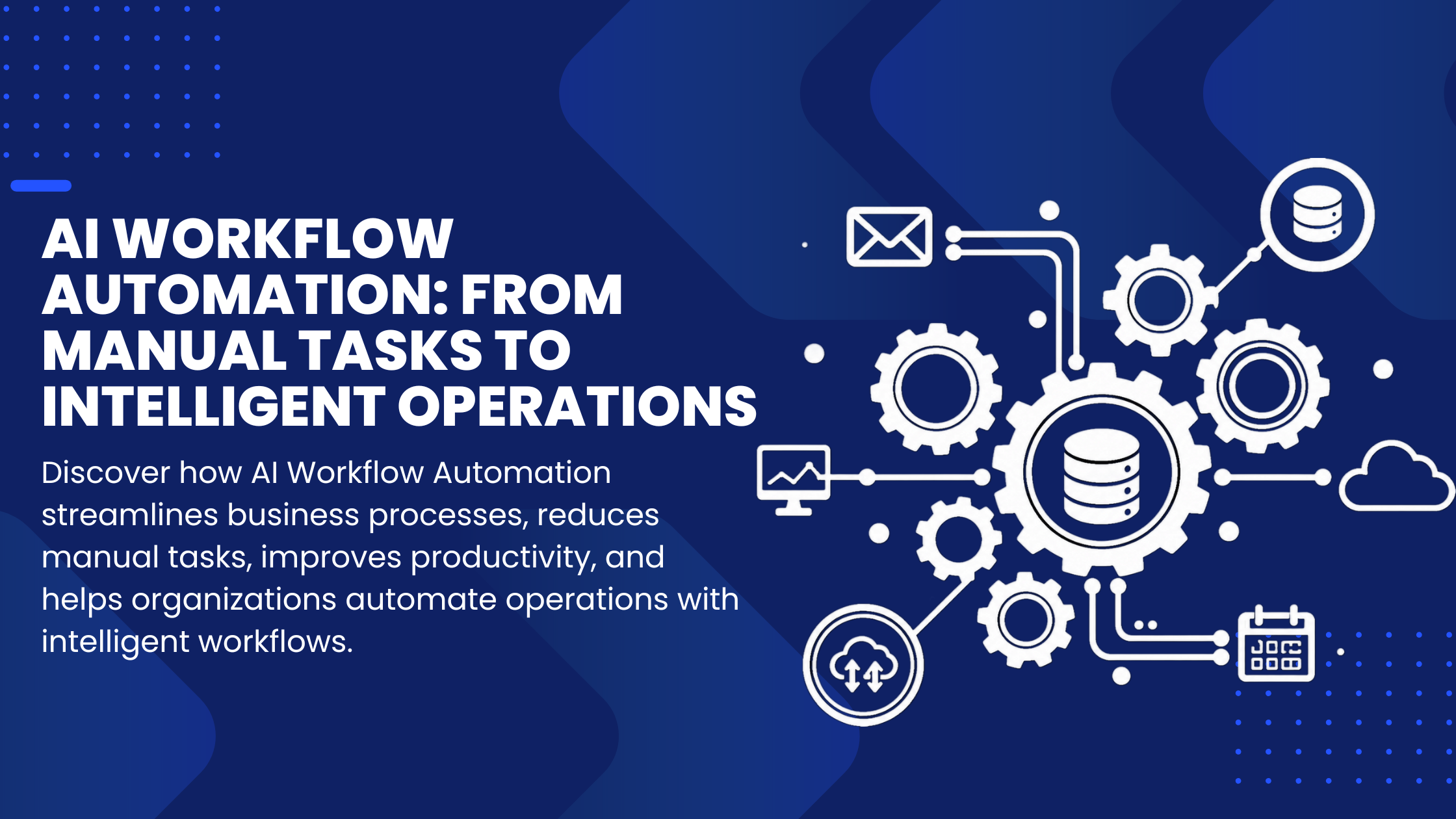
Modern businesses operate in an increasingly fast-paced environment where speed, efficiency, and accuracy determine success. Yet many organizations still rely on manual processes to complete repetitive tasks such as approving documents, assigning work, updating records, sending emails, and tracking customer interactions. These repetitive activities consume valuable time, increase operational costs, and leave room for human error.
This is where AI Workflow Automation is transforming the way businesses operate. Businesses looking for end-to-end implementation can also explore our AI Workflow Automation Services to automate repetitive processes, approvals, and business operations. By combining artificial intelligence with workflow automation, organizations can automate repetitive tasks, make smarter decisions, and streamline operations without constant human intervention.
Rather than replacing employees, AI Workflow Automation empowers teams to focus on strategic work while intelligent systems handle routine business processes in the background.
Whether you’re managing sales, customer service, HR, finance, or operations, AI-powered workflows can significantly improve efficiency, productivity, and customer satisfaction.
What Is AI Workflow Automation?
AI Workflow Automation is the process of using Artificial Intelligence to automate business workflows, optimize decision-making, and reduce manual effort across an organization.
Traditional workflow automation follows predefined rules. For example, when an invoice is submitted, it is automatically sent to a manager for approval.
AI Workflow Automation goes much further.
Instead of simply following fixed rules, AI can:
- Analyze business data
- Understand patterns
- Predict outcomes
- Make recommendations
- Trigger intelligent actions
- Learn from previous interactions
- Continuously improve workflows
The result is smarter, faster, and more adaptive business operations.
Why Businesses Need AI Workflow Automation
Many organizations begin with AI Business Process Automation to eliminate manual tasks across HR, finance, sales, operations, and customer support.
Examples include:
- Data entry
- Email responses
- Lead assignments
- Customer follow-ups
- Invoice approvals
- Employee onboarding
- Task assignments
- Document processing
- Meeting scheduling
- Report generation
When these tasks are performed manually, businesses experience:
- Delayed operations
- Human errors
- Missed deadlines
- Inconsistent processes
- Higher operational costs
- Lower employee productivity
AI Workflow Automation eliminates these inefficiencies by allowing intelligent systems to complete repetitive work automatically.
How AI Workflow Automation Works
AI Workflow Automation combines several advanced technologies to automate complex business operations.
The process typically includes:
Data Collection
The system gathers information from CRM platforms, ERP software, websites, emails, forms, databases, and third-party applications.
AI Analysis
Artificial Intelligence analyzes customer behavior, workflow history, business rules, and operational patterns.
Intelligent Decision-Making
Instead of relying solely on predefined rules, AI evaluates available data and recommends the best course of action.
Workflow Execution
The system automatically performs actions such as:
- Creating tasks
- Assigning employees
- Sending notifications
- Updating records
- Generating reports
- Approving requests
- Triggering integrations
Continuous Learning
As more data becomes available, AI continuously improves workflow accuracy and operational performance.
Key Features of AI Workflow Automation
Modern AI Workflow Automation platforms include a wide range of intelligent capabilities.
Intelligent Workflow Routing
Automatically assign tasks, tickets, approvals, or customer inquiries to the right employee or department based on workload, skills, priority, or predefined conditions.
Smart Task Automation
Create, update, assign, and monitor business tasks automatically while ensuring deadlines and priorities are always maintained.
AI Decision Support
AI evaluates historical data and business conditions to recommend the next best action instead of relying only on static workflows.
Document Processing
Automatically extract information from invoices, contracts, purchase orders, forms, and PDFs without manual data entry.
Automated Notifications
Send emails, SMS messages, Slack notifications, or CRM alerts automatically whenever workflow events occur.
Workflow Analytics
Track workflow performance through real-time dashboards showing bottlenecks, processing times, completion rates, and operational efficiency.
Benefits of AI Workflow Automation
Implementing AI Workflow Automation provides measurable business benefits.
Increase Productivity
Employees spend less time on repetitive administrative work and more time on activities that generate value.
Reduce Human Errors
Automated workflows follow consistent business rules, significantly reducing mistakes caused by manual data entry or forgotten tasks.
Improve Operational Efficiency
Business processes become faster, more accurate, and easier to manage across departments.
Accelerate Customer Response
AI automatically routes customer inquiries, sends confirmations, and initiates follow-ups, improving customer satisfaction.
Lower Operational Costs
Automation reduces labor-intensive tasks, allowing businesses to accomplish more without increasing headcount.
Better Business Visibility
Managers gain real-time insights into workflow performance, enabling faster decisions and continuous improvement.
AI Workflow Automation Across Business Departments
AI Workflow Automation benefits nearly every department within an organization.
Sales
- Lead assignment
- Opportunity tracking
- Follow-up reminders
- Proposal generation
- CRM updates
- Sales forecasting
Marketing
- Email automation
- Lead nurturing
- Campaign management
- Audience segmentation
- Content approvals
Customer Support
- Ticket routing
- AI chatbots
- Case escalation
- Customer notifications
- SLA monitoring
Human Resources
- Employee onboarding
- Leave approvals
- Performance reviews
- Recruitment workflows
- Training reminders
Finance
- Invoice approvals
- Payment processing
- Expense management
- Purchase requests
- Financial reporting
Operations
- Inventory approvals
- Procurement workflows
- Vendor management
- Asset tracking
- Internal requests
Real-World Examples of AI Workflow Automation
Businesses worldwide are using AI Workflow Automation to streamline operations.
Healthcare
Hospitals automate patient scheduling, appointment reminders, medical document processing, and insurance approvals.
Real Estate
Property inquiries are automatically assigned to agents, appointments are scheduled, and follow-up communications are sent without manual intervention.
E-commerce
Orders trigger inventory updates, shipping notifications, invoice generation, and customer emails automatically.
Manufacturing
AI monitors production workflows, predicts maintenance requirements, and automates procurement approvals.
Financial Services
Banks automate loan processing, compliance verification, fraud detection, and customer onboarding.
AI Workflow Automation vs Traditional Workflow Automation
While both approaches improve efficiency, AI Workflow Automation provides much greater flexibility.
| Traditional Workflow | AI Workflow Automation |
|---|---|
| Rule-based automation | Intelligent automation |
| Fixed conditions | Learns from data |
| Manual optimization | Continuous improvement |
| Limited adaptability | Dynamic decision-making |
| Static workflows | Predictive workflows |
| Basic reporting | AI-powered insights |
AI allows workflows to evolve as business needs change.
Industries That Benefit from AI Workflow Automation
AI Workflow Automation is valuable across many industries.
Popular sectors include:
- Healthcare
- Real Estate
- Education
- Financial Services
- Manufacturing
- Logistics
- Retail
- E-commerce
- Construction
- Insurance
- Hospitality
- Professional Services
Each industry benefits from improved efficiency, lower costs, and faster service delivery.
Best Practices for Implementing AI Workflow Automation
Successful implementation starts with careful planning.
Identify Repetitive Processes
Focus on workflows that consume significant employee time.
Standardize Business Rules
Clearly define workflow steps before introducing AI.
Integrate Existing Systems
Connect AI workflows with CRM, ERP, HR, accounting, and communication platforms.
Train Employees
Help teams understand how AI supports not replaces their daily responsibilities.
Monitor Performance
Measure KPIs such as processing time, response rates, error reduction, and productivity improvements.
Continuously Optimize
Regularly review workflow performance and refine automation based on business needs.
Common Challenges of AI Workflow Automation
Although AI Workflow Automation offers significant advantages, organizations should prepare for common challenges.
These include:
- Poor-quality data
- Legacy software integration
- Employee resistance to change
- Process complexity
- Initial implementation costs
- Security and compliance requirements
With proper planning and change management, these challenges can be successfully addressed.
The Future of AI Workflow Automation
AI Workflow Automation continues to evolve rapidly.
Future developments include:
- Autonomous AI agents
- Generative AI for workflow creation
- Predictive business operations
- Hyper-personalized automation
- Natural language workflow design
- Intelligent process mining
- Self-optimizing workflows
- Advanced business intelligence
As AI technology matures, businesses will automate increasingly complex operations while improving customer experiences and operational performance.
Frequently Asked Questions
What is AI Workflow Automation?
AI Workflow Automation uses Artificial Intelligence to automate repetitive business processes, improve decision-making, and optimize operational efficiency.
Which business processes can be automated?
Sales, marketing, HR, finance, customer support, procurement, document management, project management, approvals, and many other repetitive workflows.
Is AI Workflow Automation suitable for small businesses?
Yes. Businesses of all sizes can automate repetitive tasks, reduce manual work, improve productivity, and scale operations more efficiently.
Can AI Workflow Automation integrate with existing software?
Yes. Modern solutions integrate with CRM systems, ERP software, accounting platforms, cloud applications, communication tools, APIs, and custom business systems.
Does AI Workflow Automation replace employees?
No. AI handles repetitive and time-consuming tasks, allowing employees to focus on strategic work, customer relationships, creativity, and business growth.
Final Thoughts
AI Workflow Automation is reshaping how organizations operate by replacing repetitive manual tasks with intelligent, data-driven workflows. From streamlining approvals and automating customer interactions to improving collaboration across departments, AI enables businesses to work faster, reduce costs, and make better decisions.
As organizations continue their digital transformation journey, adopting AI Workflow Automation is no longer just an efficiency upgrade it is a strategic investment in long-term growth and competitiveness. Businesses that embrace AI-powered workflows today will be better equipped to adapt to changing market demands, deliver exceptional customer experiences, and build scalable operations for the future.