Skip to content
Leads rarely disappear because customers lose interest. More often, they vanish because no one followed up, important conversations stayed buried in inboxes, or a spreadsheet wasn’t updated after a busy day.
That’s an expensive problem.
Many growing businesses assume they need more leads to increase revenue when the real issue is managing the opportunities they already have. Missed callbacks, inconsistent follow-ups, and poor visibility into deals create leaks throughout the sales funnel that quietly reduce monthly revenue.
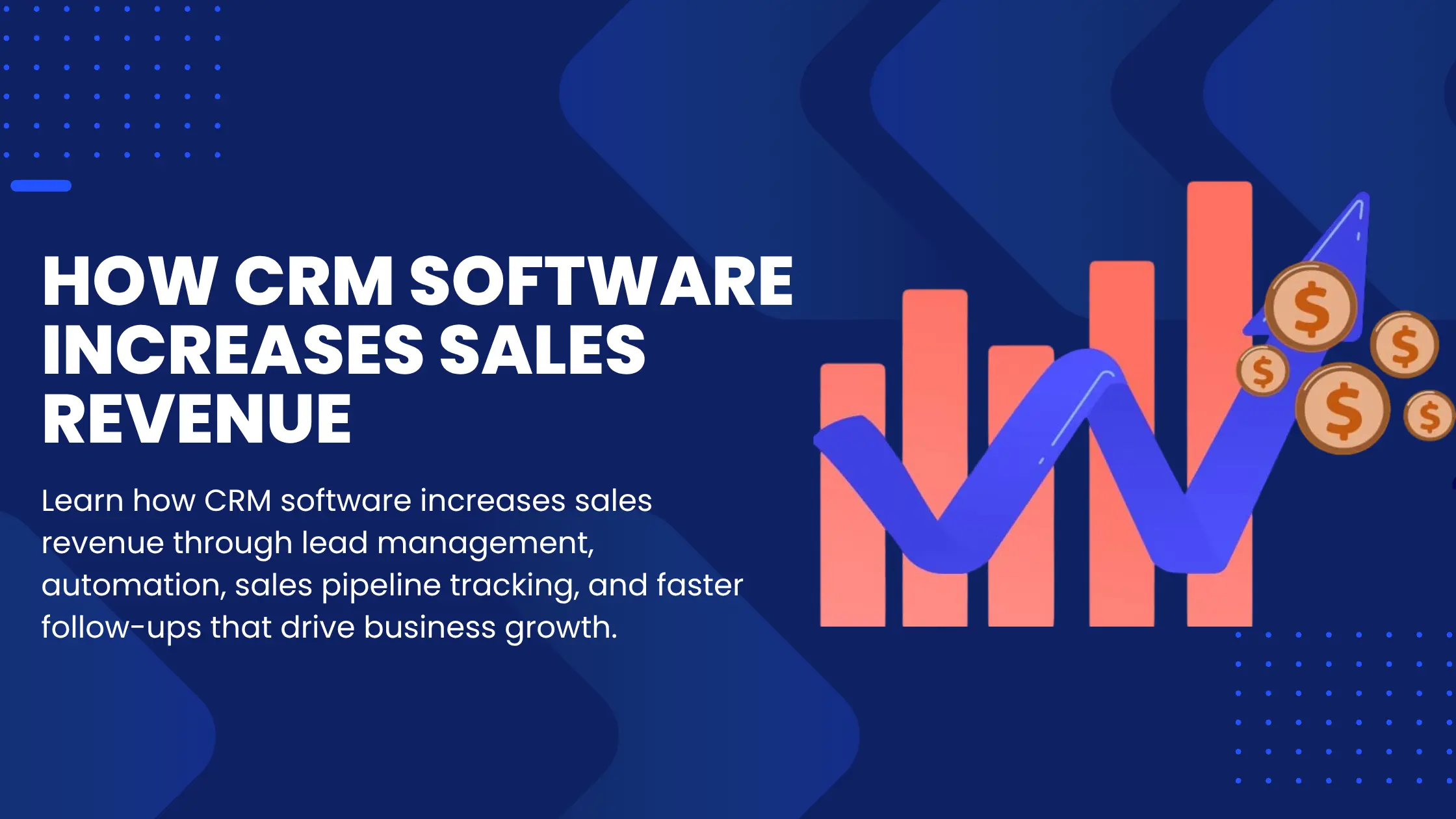
This is exactly how CRM software increases sales revenue. A modern CRM isn’t just a place to store contacts. It’s a revenue engine that captures every interaction, keeps sales teams organized, automates repetitive work, and ensures opportunities don’t slip through the cracks.
When every lead is tracked, every salesperson knows their priorities, and every deal moves through a structured process, revenue growth becomes far more predictable.
The 60/40 Productivity Problem Holding Sales Teams Back
One of the biggest challenges facing sales organizations in 2026 isn’t a shortage of prospects.
It’s a shortage of selling time.
Industry research consistently shows that sales representatives spend roughly 60% of their workweek on administrative work logging activities, updating spreadsheets, searching for customer information, switching between multiple tools, and writing manual follow-up emails. That leaves only about 40% of their time for actual selling.
Without a CRM, daily work often looks like this:
- Searching email threads for previous conversations
- Updating multiple spreadsheets after every meeting
- Manually scheduling reminders
- Copying notes between systems
- Looking for proposal versions
- Guessing which lead should be contacted next
Every minute spent on administrative work is time that isn’t generating revenue.
A CRM changes this workflow through intelligent automation.
Instead of requiring manual updates, modern platforms automatically:
- Log calls and emails
- Record customer activity
- Store communication history in one location
- Update customer records automatically
- Create follow-up reminders
- Synchronize meetings and calendars
Sales representatives spend less time maintaining records and more time building relationships.
That shift is one of the clearest examples of how CRM software increases sales revenue because selling hours not administrative hours produce income.
Four Ways CRM Software Directly Drives Revenue
Precision Lead Tracking: No Buyer Left Behind
Every missed lead represents money left on the table.
Without proper lead tracking automation, businesses struggle to understand where prospects came from, which conversations already happened, and which opportunities require immediate attention.
A CRM keeps every interaction attached to the customer record.
Instead of relying on memory, sales teams instantly see:
- Website inquiries
- Email conversations
- Phone calls
- Meeting notes
- Proposal history
- Product interest
Modern CRMs also use lead scoring to prioritize prospects based on buying intent. High-value leads automatically move to the top of the queue, helping sales teams focus their energy where it matters most.
This dramatically reduces the number of opportunities that quietly go cold.
Rather than reacting to missed opportunities, businesses actively manage them before revenue is lost.
Intelligent Follow-Up Automation: Winning the Speed-to-Lead Race
Response time directly influences conversion rates.
A prospect who requests information today expects a response today not next week after someone remembers to check a spreadsheet.
This is where lead tracking automation becomes especially valuable.
Instead of relying on manual reminders, CRM workflows automatically trigger actions such as:
- Welcome emails
- Demo scheduling
- Follow-up sequences
- Proposal reminders
- Renewal notifications
- Internal sales alerts
Automation doesn’t replace personal selling.
It removes repetitive tasks that delay it.
Sales representatives can personalize conversations while the CRM handles scheduling, reminders, and repetitive communication.
The result is faster engagement, stronger customer experiences, and higher conversion rates.
For businesses looking to improve B2B sales velocity, speed often becomes a competitive advantage.
Optimizing the Sales Pipeline: Spotting Bottlenecks Before They Cost You
Healthy revenue depends on healthy sales pipeline management.
Without visibility into the pipeline, managers often discover problems after revenue targets have already been missed.
Modern CRM dashboards provide real-time insight into every opportunity moving through the funnel.
Instead of asking where deals stand, leaders immediately know:
- Number of active opportunities
- Average deal value
- Stage conversion rates
- Sales representative performance
- Pipeline coverage
- Forecast accuracy
Simple pipeline visualization often reveals hidden issues.
Sales Pipeline Example
If dozens of deals consistently stall between proposal and negotiation, leadership can investigate pricing, sales messaging, or approval delays before those bottlenecks affect quarterly revenue.
This level of sales pipeline management creates predictable forecasting instead of educated guessing.
Organizations also report stronger pipeline visibility after CRM implementation, allowing managers to identify risks earlier and coach sales teams more effectively.
Compressing the Sales Cycle: Closing Deals Faster
Every additional day a deal remains open creates uncertainty.
The longer opportunities stay in the pipeline, the greater the chance competitors enter the conversation or priorities change.
One reason businesses see measurable ROI is their ability to reduce sales cycle length.
Industry benchmarks show well-implemented CRM systems can shorten average sales cycles by 8–14 days.
That happens because information becomes immediately available.
Sales teams no longer waste time searching for:
- Previous conversations
- Pricing documents
- Contracts
- Customer requirements
- Decision-maker details
Everything lives inside a centralized workspace.
Quicker access leads to quicker responses.
Quicker responses build buyer confidence.
Faster decision-making improves B2B sales velocity, allowing organizations to close more opportunities within the same quarter.
This is another practical example of how CRM software increases sales revenue through operational efficiency rather than simply increasing lead volume.
The 2026 Edge: Clean Data Meets AI
Technology alone isn’t enough.
A CRM is only as valuable as the quality of the information inside it.
Today, CRM adoption is approaching 90% among companies with more than 10 employees, yet many organizations still struggle because duplicate contacts, incomplete records, and outdated customer information reduce forecasting accuracy and waste selling time.
Poor data quality has a direct impact on revenue.
Modern CRM platforms are addressing this challenge with built-in generative AI and intelligent AI agents.
Instead of asking salespeople to perform more manual work, these systems now:
- Automatically summarize customer meetings
- Generate call notes
- Recommend next actions
- Identify high-intent prospects
- Score leads using behavioral signals
- Reduce repetitive data entry
The result is cleaner records, more consistent forecasting, and better decisions across the revenue team.
Turn Your CRM Into a Revenue Engine
Businesses rarely struggle because they lack opportunities.
More often, they struggle because opportunities aren’t managed consistently.
The organizations seeing the strongest returns treat their CRM as the center of every customer interaction rather than a reporting tool used at the end of the week. When implemented correctly, CRM platforms have historically delivered up to a 29% improvement in sales performance, stronger pipeline visibility, and faster deal progression.
That’s the real answer to how CRM software increases sales revenue.
Audit your current sales process.
Identify where leads disappear, where follow-ups slow down, and where your team spends time on repetitive administrative work.
If your salespeople spend more time updating systems than speaking with customers, your technology isn’t supporting growth it may be limiting it.
The businesses that fix those pipeline leaks today are the ones that build predictable, scalable revenue tomorrow.